
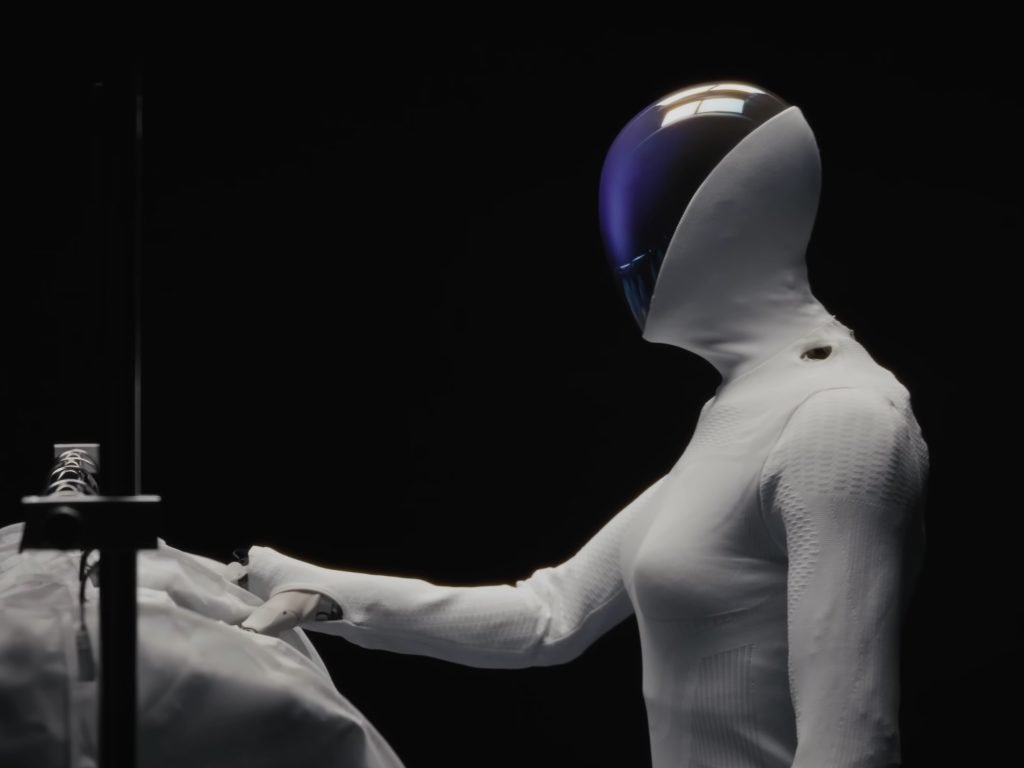
XPENG is taking a major step into the humanoid robotics industry after its Physical AI business raised more than $900 million in new funding, giving the division an estimated valuation of $6.3 billion.
The investment marks a significant milestone for XPENG as the Chinese electric vehicle manufacturer expands beyond cars and autonomous driving into the rapidly developing field of Physical AI and humanoid robots.
The company secured the investment through a series of share purchase agreements involving several major investors. XPENG described the transaction as one of the largest private funding rounds for Physical AI in China, based on both the amount raised and the valuation achieved.
The funding will be used to accelerate the development of IRON, XPENG’s humanoid robot platform, as the company prepares to move from technology development toward large-scale manufacturing and commercial applications.
XPENG Expands Beyond Electric Vehicles
XPENG has built its reputation primarily as an electric vehicle manufacturer, but the company has increasingly invested in artificial intelligence, autonomous driving, robotics, and other advanced technologies.
He Xiaopeng, Chairman and CEO of XPENG, said the company has spent the past 12 years developing core technologies internally.
According to He, XPENG’s investments in AI models, computing infrastructure, and proprietary AI chips have created the technological foundation needed to enter the Physical AI era.
The company believes this foundation can help it develop robots capable of interacting with the physical world in ways that are similar to humans.
Rather than treating humanoid robotics as a separate business, XPENG is attempting to combine its experience in AI, automotive engineering, manufacturing, supply chains, and autonomous driving into a single robotics strategy.
Major Investors Back XPENG’s Robotics Business
The latest funding round was led by IDG Capital, while Gaorong Ventures also participated.
Technology giants Tencent and Alibaba joined the investment as strategic backers, highlighting the growing interest in humanoid robots and Physical AI among major Chinese technology companies.
XPENG will continue to control the robotics business following the completion of the transaction. The division will also remain part of XPENG Group’s consolidated financial statements.
The company intends to invest the new capital over the long term rather than focusing solely on short-term commercialization.
Investment will cover robot hardware, software, AI model training, data generation, production infrastructure, and international market expansion.
XPENG also plans to strengthen employee incentive programs to attract and retain experienced engineers, executives, and other specialists working on Physical AI.
What Makes the IRON Humanoid Robot Different?
IRON is the centerpiece of XPENG’s robotics ambitions.
The robot has been designed with a flexible, fully enclosed body structure intended to provide a combination of human-like appearance, movement, and safety.
XPENG says IRON has 76 degrees of freedom throughout its body, with each hand providing 21 degrees of freedom.
These capabilities are designed to allow the robot to perform more sophisticated movements and handle objects with greater precision.
The company has developed much of the robot’s hardware internally, including key chips, controllers, movement systems, and dexterous hand mechanisms.
This vertical integration reflects XPENG’s approach to vehicle manufacturing, where the company develops and controls a large portion of its underlying technology.
XPENG also plans to apply automotive-grade manufacturing and quality standards to humanoid robot production.
That could become an important advantage if the company succeeds in moving humanoid robots from small-scale prototypes to mass-market products.
2,250 TOPS of AI Computing Power
Another key feature of IRON is its onboard computing capability.
XPENG says the humanoid robot can deliver up to 2,250 TOPS of effective computing performance through three proprietary Turing AI chips.
The processing power allows AI models to operate directly on the robot instead of relying entirely on remote cloud computing.
Local processing can help reduce response times and allow the robot to make decisions more quickly when interacting with its surroundings.
For a humanoid robot operating in dynamic environments, low-latency processing can be particularly important.
XPENG also believes IRON’s human-like physical structure will help it collect useful data from environments designed for people.
The company expects this combination of hardware, AI models, and real-world data to create a continuous improvement cycle.
As more robots are deployed, more data can potentially be collected. That data can then be used to improve AI models, which could make the robots more capable of handling additional tasks.
IRON Could Enter Mass Production in 2026
XPENG is targeting mass production of IRON by the end of 2026.
However, the first robots are not expected to immediately become widely available to consumers.
The initial deployment is planned for XPENG’s own stores, offices, and campuses. This internal rollout will allow the company to test the robots in real-world environments and gather additional operational data.
XPENG plans to move toward customer deliveries in China and international markets during 2027.
The transition from internal testing to commercial deployment will be an important test of whether XPENG can successfully turn its robotics technology into a scalable business.
Physical AI Moves Toward Commercialization
The latest investment also reflects a broader change taking place across the robotics industry.
For years, humanoid robots were largely viewed as research projects or technology demonstrations. Companies are now attempting to develop robots that can be manufactured at scale and perform useful tasks in factories, stores, warehouses, offices, and eventually homes.
IDG Capital believes the Physical AI industry is entering a new phase in which technological breakthroughs must be followed by scalable manufacturing and commercial deployment.
The investment firm highlighted XPENG’s combination of AI processors, foundation models, robotics technology, and automotive manufacturing capabilities.
Gaorong Ventures also pointed to the importance of moving beyond demonstrations of walking and dexterity.
For humanoid robots to become commercially successful, they need to operate reliably, safely, and consistently in real-world environments.
XPENG’s experience in automotive production could therefore provide an important foundation for its robotics ambitions.
Competition in the Humanoid Robot Market Is Increasing
XPENG is entering an increasingly competitive market.
Technology companies, robotics startups, and automotive manufacturers around the world are investing heavily in humanoid robots.
The competition is no longer focused solely on making a robot walk or move like a human. Companies are now competing on AI intelligence, dexterity, battery life, computing power, manufacturing costs, safety, and the ability to perform useful work.
XPENG’s strategy is to leverage technologies originally developed for electric vehicles and autonomous driving and apply them to humanoid robotics.
If successful, the company could benefit from its existing manufacturing infrastructure and supply-chain expertise.
A New Direction for XPENG
The large funding round gives XPENG significant financial resources to pursue its long-term robotics strategy.
He Xiaopeng said the company wants IRON to combine a human-like form with advanced AI capabilities and high standards for safety and quality.
The ultimate goal is to make the robot useful in everyday environments rather than simply using it as a demonstration of technological capability.
XPENG hopes IRON can eventually become a trusted assistant for people, supporting tasks in workplaces and potentially becoming part of daily life.
The planned 2026 mass-production target and 2027 customer deliveries could represent a major turning point for XPENG.
If the company can successfully scale production while maintaining reliability and affordability, IRON could become an important player in the global humanoid robotics market.
For now, the $900 million-plus investment and $6.3 billion valuation show that investors are willing to place substantial capital behind XPENG’s vision of a future where artificial intelligence is no longer limited to screens and software, but can physically interact with the world around us.