NVIDIA is using Palantir Foundry and NVIDIA cuOpt to automate and optimize hardware supply chain allocation across its global manufacturing network. The system helps NVIDIA manage complex component dependencies, factory capacity constraints, and customer fulfillment requirements while reducing the time required to move hardware from wafer production to operational deployment.
NVIDIA measures supply chain performance from wafer-out to first token, a window that captures the time required to transform semiconductor output into a fully operational data center system. This process includes time-to-rack, covering transportation and system assembly, and time-to-token, which includes power, cooling, networking, and software readiness.
Managing NVIDIA Grace Blackwell and Vera Rubin Supply Chains
The rapid expansion of NVIDIA’s AI infrastructure has increased pressure on its global hardware supply chain. A NVIDIA Grace Blackwell NVL72 rack includes 18 compute trays, with each tray requiring two Grace CPUs, four Blackwell GPUs, and 32 HBM3e memory packages. These components are supplied through thousands of suppliers, OEMs, and contract design partners.
NVIDIA’s upcoming Vera Rubin architecture is expected to require a supply chain network roughly twice the size of the one supporting Grace Blackwell.
Manufacturing cannot begin until required components arrive through one of three supply channels: direct inventory, consignment stock, or external suppliers. Delayed components can force early shipments to wait, increasing what NVIDIA calls Time of Ownership (TOO) — the period between a facility receiving materials and completed sub-assemblies leaving the facility.
To address these challenges, NVIDIA continuously adjusts factory allocations on a weekly basis across rolling two-quarter planning horizons. These allocation decisions account for component availability, factory throughput, production constraints, and customer delivery schedules.
NVIDIA Uses cuOpt for Supply Chain Optimization
NVIDIA built a Digital Supply Chain Intelligence command center using Palantir Foundry to coordinate these complex supply chain decisions. Palantir Foundry’s Ontology represents facilities, supplier commitments, component inventories, and production targets as interconnected operational objects.
NVIDIA’s cuOpt, a GPU-accelerated decision optimization library, operates on this data layer to solve complex allocation problems. The system formulates supply chain distribution as a mixed-integer linear programming (MILP) problem designed to minimize Time of Ownership.
Rather than focusing only on delivery schedules, cuOpt evaluates constraints throughout the bill of materials and identifies bottlenecks that could affect production. These may include regional assembly capacity limits, component shortages, or insufficient memory availability.
This approach allows NVIDIA to make more informed factory allocation and supply chain planning decisions across its manufacturing ecosystem.
Training Nemotron AI Models for Supply Chain Decisions
Traditional mathematical optimization was not enough to capture every factor affecting NVIDIA’s supply chain. Human planners also consider unstructured information such as supplier communications, call transcripts, weather forecasts, partner emails, and geopolitical developments.
To incorporate these qualitative signals, NVIDIA post-trained Nemotron 3.5 Lightning, an open-weight mixture-of-experts AI model with 30 billion total parameters and approximately three billion active parameters per forward pass.
NVIDIA’s training pipeline uses several AI development tools. NeMo Anonymizer removes sensitive operational information, while NeMo Data Designer creates balanced training datasets and synthetic supply disruption scenarios. NeMo AutoModel applies low-rank adaptation (LoRA) while keeping the model’s base weights frozen.
Meanwhile, Palantir Autopilot manages data lineage, model tracking, and the delivery of AI-generated recommendations.
AI Model Improves NVIDIA Supply Chain Allocation Accuracy
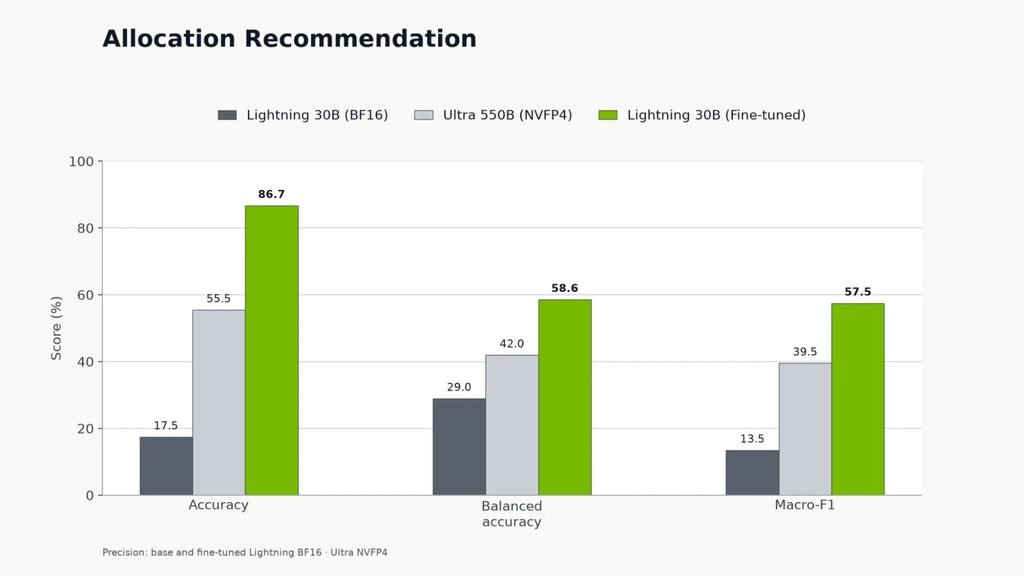
NVIDIA evaluated the post-trained Nemotron 3.5 Lightning model against historical supply chain allocation records. The model achieved 86.7% decision accuracy, compared with 55.5% for the larger Nemotron 3 Ultra model and 17.5% for the untuned Lightning base model.
The post-trained model also reached 58.6% balanced accuracy and a 57.5% macro-F1 score. This compared with 42% balanced accuracy and 39.5% macro-F1 for Nemotron 3 Ultra.
Fine-tuning was completed within minutes using two NVIDIA B200 GPUs. The results indicate that domain-specific training can significantly improve AI-assisted supply chain allocation, although predicting production risks further into the future remains challenging.
Combining AI, Optimization, and Human Supply Chain Planning
NVIDIA’s system combines GPU-accelerated optimization, generative AI, operational data, and human planner decisions into a continuous supply chain intelligence workflow.
Factory decisions, planner revisions, manual overrides, and actual production results are continuously written back into the Palantir Ontology. This creates an operational feedback loop that can be used to evaluate and improve future allocation recommendations.
NVIDIA also plans to use this operational dataset to create preference pairs for reinforcement learning. Future models can be evaluated based on allocation accuracy, policy compliance, and evidence grounding.
However, NVIDIA maintains strict separation between production systems and live, unmonitored model retraining, helping reduce the operational risks associated with continuously updating AI models in critical manufacturing environments.
The Future of AI-Powered Supply Chain Optimization
NVIDIA’s use of Palantir Foundry, cuOpt, and Nemotron demonstrates how AI can move beyond supply chain visibility toward automated decision-making and optimization.
For increasingly complex AI hardware supply chains, the challenge is no longer simply identifying shortages. Companies must determine which factory should receive which components, when production should be prioritized, and how limited capacity should be allocated to meet customer demand.
By combining real-time operational data with mathematical optimization and domain-trained AI models, NVIDIA is building a more intelligent approach to global supply chain management, factory allocation, and AI infrastructure production.